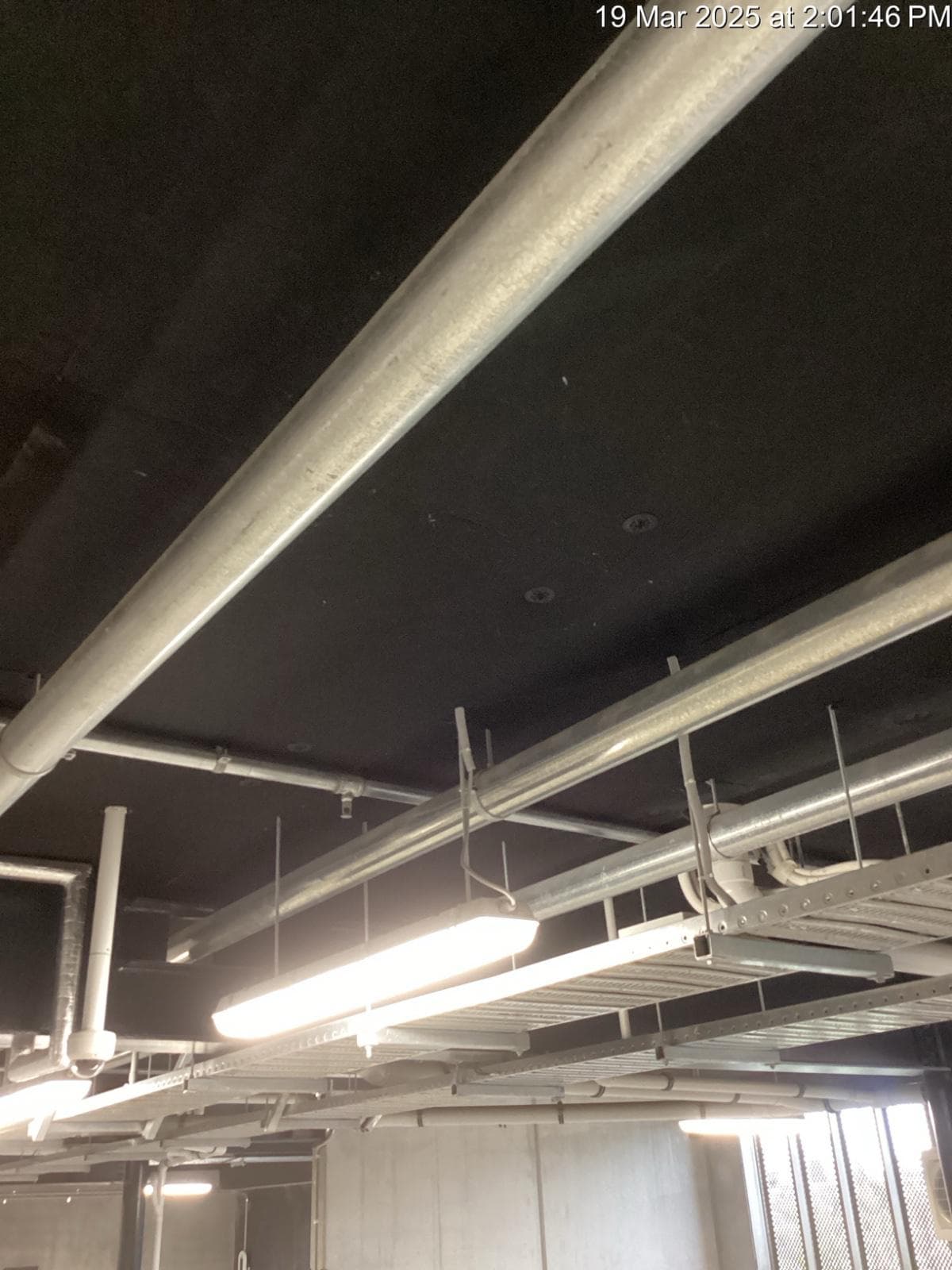
Fixings & Adhesives Carpark Soffits
The install instructions are the warranty.
Here is what they actually say.
- Five systems compared
- Manufacturer sourced
- Post-tensioned slabs
- Green concrete
Auckland based, nationwide
We travel. Most regions have no carpark soffit crew of their own.
Programme focused
We plan and deliver around your schedule.
QA & PS3 supplied
Complete documentation at practical completion.
Commercial specialists
Carparks, basements and podiums.
Insulation is fixed to a concrete carpark soffit in one of four ways. Shot-fired or gas-actuated insulation anchors. Drilled insulation pins with a one-way washer or dome. A suspended grid of furring channel or battens. Or adhesive. Which one is permitted is not an installer's preference. It is set by the product manufacturer's published install instructions, and it is the condition on which the product warranty depends.
Why do the fixing schedules matter?
On most carpark jobs somebody asks us to fix the insulation a different way than the manufacturer specifies. Usually to save time, sometimes to get around a services clash, occasionally because the slab turned out to be post-tensioned and nobody wanted to have that conversation at tender.
Sometimes the request is reasonable and the manufacturer allows it. Often it is not, and agreeing would transfer a liability from the person asking to us, and from us to whoever owns the building in twenty years.
The install instructions and the datasheet are not paperwork. They are the warranty. Every one of the systems we install states, in its own warranty document, that the warranty applies only where the product was installed in accordance with the manufacturer's instructions. Deviate and the warranty does not get weakened — it never engages.
How many fixings does carpark soffit insulation need?
Each manufacturer publishes only their own schedule. Set side by side, they do not agree — and a fixing pattern that is compliant on one product is non-compliant on another.
| GreenStuf ASL | Mammoth Carpark Panel | Kingspan Kooltherm K10 G2 | GreenStuf Phenolic | |
|---|---|---|---|---|
| Fixings per 2400 × 1200 panel | 11 | 11–12 | Minimum 11 (3.81/m²) | 5–6 |
| Maximum centres | 600mm | Not stated | Set by the 11-fixing pattern | 600mm across, 400mm along |
| Distance from panel edge | Min 100mm, max 200mm | Not stated | No less than 50mm, no more than 150mm | Minimum 50mm |
| Minimum head diameter | Not stated | Smaller heads require higher frequency | 35mm | Not stated |
| Embedment into concrete | Not stated | Not stated | 40mm (Masterspec 4711KS) | 25mm (masonry screws) |
| Fastener length rule | Equal to panel thickness | Not stated | Not stated | Not stated |
| Named fastener | Hilti | Hilti X-IE6 / Ramset Insulfast | None — consult the fastener supplier | None |
| Adhesive | Permitted, conditional | Conditional — narrow | Not a published method | Not mentioned |
The schedules are not interchangeable. GreenStuf ASL allows a fixing up to 200mm from the panel edge. Kingspan allows a maximum of 150mm and requires a minimum 35mm head. Run one schedule across a job with two products on it and one of them is non-compliant.
Kingspan is the only manufacturer that explains why eleven fixings, and the reasoning is about your slab rather than their product.
“There will always be differential expansion and contraction between any rigid insulation material and adjacent building products due to varying moisture content and temperature. In any concrete forming, there will be an uneven surface throughout the slab. Where concrete formwork is joined it is normal to have ridges of up to 3mm which make the concrete surface uneven. An insulation board held horizontally may bow like any other sheet material under its own weight.”
That is the manufacturer describing exactly what we deal with on every job. Carpark soffits are not flat, formwork joints leave ridges, and the fixing count exists to hold a panel against a surface that is not true — overhead, for the life of the building.
Why does no New Zealand anchor meet Kingspan's 40mm requirement?
Kingspan's Masterspec section 4711KS requires insulation fasteners with a minimum 35mm head diameter and 40mm penetration into solid substrate.
No shot-fired insulation anchor available in New Zealand reaches 40mm.
Hilti X-IE 6 and X-IE 9 both embed 24 to 29mm across every length in the range. Hilti's drilled IDP anchor embeds 25mm. Fischer's DHK 60 requires a minimum 30mm drill depth. The head diameters are all fine — 60mm on the X-IE 6 and Ramset InsulFast T4, 90mm on the X-IE 9, comfortably past Kingspan's 35mm. It is the depth that does not comply.
The Sesto fastener, the ICCONS GTIF, is the one we use on most carpark soffits, and on a Kooltherm job it needs a step the polyester jobs do not. Neither Sesto nor ICCONS publishes a head diameter or an embedment depth for it, so neither figure can be checked against Kingspan's requirement from published data. On the sibling powder-actuated range the whole drive pin is 37 to 52mm, and once the insulation thickness it has to pass through is subtracted the concrete embedment is well under 40mm. We worked that out from the published pin length; Sesto do not state it. So on Kooltherm we get the head diameter and the embedment from Sesto in writing before the job is priced. On the polyester systems it does not arise, because no polyester manufacturer specifies either figure.
If Kooltherm K10 is specified to Kingspan's own Masterspec text and fixed with a standard insulation anchor, the fixing is arguably non-conforming on embedment. That is a question to resolve at specification stage with Kingspan and the fastener supplier, in writing. It is a very poor thing to discover at PS3.
We raise it at tender on every Kooltherm job. The alternative is that somebody signs a producer statement for an installation that does not meet the specification it was priced against.
What do insulation anchors actually cost on a carpark?
Shot-fired and gas-actuated insulation anchors are the default. On a carpark they are also a consumable line item that gets under-priced more often than any other part of the job. The fastener we use on most carpark soffits is the Sesto insulation fastener, the ICCONS GTIF, supplied in New Zealand by Sesto Fasteners. Hilti and Ramset are the two brands manufacturers tend to name in their install guides, so all three are compared below.
The stick rate nobody prices for
Hilti publish a stick rate for the X-IE fastener — the percentage of nails driven correctly that will carry a load. It is 90 to 95 percent in soft and medium concrete, 15 to 45 MPa. It drops to 85 to 90 percent in tough concrete, 45 to 65 MPa. So between one in twenty and one in seven anchors will not take. Each one is money on the floor, and the replacement cannot go back in the same hole.
This is why the concrete strength on the drawings matters to us at tender and not at handover. A 25 MPa slab and a 50 MPa slab are the same job to look at and a materially different job to price.
The concrete strength window
There is a band of concrete you can shot-fire into, and it is narrower than most people assume. Below 10 MPa, WorkSafe guidance says the material is unsuitable as a base — too soft to hold. Above 60 MPa it is unsuitable because it is too hard. Hilti's X-IE window is 15 to 65 N/mm². Ramset's InsulFast T4 is rated for 25 to 45 MPa. So the fastener you can use narrows further depending on which system you are on. The slab also has to be at least 80mm thick for a Hilti X-IE, and WorkSafe guidance asks for 100mm, or three times the shank penetration, whichever is less.
Fastener comparison
| Sesto / ICCONS GTIF | Hilti X-IE 6 | Hilti X-IE 9 | Hilti IDP | Ramset InsulFast T4 | |
|---|---|---|---|---|---|
| Method | Gas or low-velocity powder actuated | Powder or gas actuated | Powder or gas actuated | Drilled, hammer-in | Gas actuated |
| Plate diameter | Not published | 60mm | 90mm | Not published | 60mm |
| Embedment | Not published | 24–29mm | 24–29mm | 25mm | Not published |
| Insulation thickness | 25–140mm in the NZ range | 20–200mm | 50–200mm | To 150mm | 25–100mm (soft to 110mm) |
| Concrete strength | 20 MPa minimum, no upper limit published | 15–65 N/mm² | 15–65 N/mm² | Concrete (tough) | 25–45 MPa |
| Min slab thickness | Not published | 80mm | 80mm | Not published | Not published |
| Recommended tension | 0.15 kN, stated as ultimate load with a safety factor above 3 | 0.4 kN soft/medium, 0.2 kN tough | Same | Not published | 0.15 kN at 25–45 MPa |
| Spacing and edge distance | 100mm minimum spacing, 100mm minimum edge distance | 100mm between fasteners, 75mm from a concrete edge | Same | Not published | Not published |
| Sizes offered | 25, 30, 35, 40, 45, 50, 60, 75, 80, 90, 100, 120, 130 and 140mm | 20–200mm range | 50–200mm range | To 150mm | 25, 38, 50, 60, 75 and 100mm |
Size range is the first practical reason we default to Sesto. The GTIF runs from 25 to 140mm across fourteen sizes, which covers every panel thickness in this category including a 140mm GreenStuf ASL R3.0. The Ramset T4 stops at 100mm of rigid insulation, 110mm soft, so on an R3.0 panel it is out.
The published tension figures differ by roughly 2.7 times between the Hilti fasteners and the other two. Different products tested on different bases, so it is not like-for-like — but if a designer is running a dead load check on the fixing, the fastener you choose changes the answer materially. Worth knowing which one was assumed.
Sesto and ICCONS do not publish a plate diameter or an embedment depth for the GTIF. On a polyester liner that does not bite, because no polyester manufacturer specifies either figure. On a Kooltherm job it does, because Kingspan specifies both, so on those jobs we get the figures from Sesto in writing.
Where a manufacturer's install guide names a specific fastener — Mammoth name the Hilti X-IE6 and the Ramset InsulFast GT3 — and the job is being fixed with something else, we confirm the substitution with the manufacturer before we start. That is the same rule the rest of this page runs on.
The fixing count arithmetic that does not quite work
Hilti's own minimum is 4 fasteners per square metre for material up to 15 kg/m², 5 above it. Eleven fixings on a 2.88 square metre panel is 3.81 per square metre — below Hilti's stated minimum. Twelve gives 4.17 and clears it. Mammoth's 11 to 12 straddles the line; GreenStuf ASL and Kingspan both say 11. We fix to the insulation manufacturer's schedule because that is what the warranty is conditional on, and we raise the arithmetic where a designer wants it resolved.
Why is Hilti always specified and rarely installed?
Hilti is the reference fastener in this category. It is what the install guides name, what the Masterspec sections point at, and what a designer writes when they want a fastener with published data behind it. It is also the one that gets substituted more than any other product on a carpark soffit. In practice the anchor that goes into the slab is a Ramset or a Sesto, chosen on price and on what the supplier can get to site this week.
Hilti publish embedment, plate diameter, minimum slab thickness, concrete strength window, recommended tension and a stick rate. Almost nobody else publishes that much, which is exactly why a specifier reaches for them. But an insulation anchor is a consumable bought by the box, in volume, on a job where the fixing is a small fraction of the rate and availability decides the programme. Consumables get bought on cost and lead time.
A specification that names a Hilti X-IE and an installation that uses something else is a substitution, whether or not anyone calls it one. A fixing substitution moves the embedment, the plate diameter, the concrete strength window and the assumed tension. If a designer has run a dead load check on a 0.4 kN figure and the fastener on site is rated 0.15 kN, that check no longer describes the building.
We name the fastener we are actually going to install at tender, by brand and part number, and we get it accepted in writing before the first box is opened. If the specification insists on Hilti, we price Hilti. We do not price one fastener, fit another, and leave the difference for somebody to find at PS3.
Does the colour of an insulation anchor mean anything?
On one brand it is cosmetic. On another it decides whether the anchor is the right one for concrete. Same two colours, opposite meanings, and both are on New Zealand sites.
Sesto — colour is finish only
The Sesto fastener is the ICCONS GTIF, and ICCONS list it in clear, black and grey, described in the product features as being for different finish. No different material, no different substrate rating and no different load figure is published for any of the three, so on a Sesto job the colour is cosmetic. The clear fastener is a translucent natural nylon that reads as off-white on a soffit, which is why crews call it white. Black is the one to reach for under a black-faced liner, where eleven pale washers per panel are the thing you see from the deck below.
Ramset InsulFast T4 — colour is the substrate rating
Ramset run the same two colours and mean something completely different by them. White anchors are designed for masonry, concrete and hollow block substrates; black anchors are designed for timber and steel stud substrates. A carpark soffit is concrete. So on a Ramset job the black anchor is the wrong anchor, and it is wrong in a way that is invisible once the panel is up.
Black costs more on both brands. No New Zealand merchant publishes a rate for either, since both are trade-channel products. The one public figure we could find is Australian retail: a box of 50 clear ICCONS GTIF at around AUD 37.75 against roughly AUD 56 to 65 for the black. Those are Australian retail prices, so read the direction rather than the number. It matters on a carpark because a black-faced liner is the specification that calls for the black fastener, and it is the one that costs most per pin.
The reason is stocking. Clear is the full stocked range, black runs to four sizes and grey to three, and Sesto will modify other sizes to colour on request. A short-run colour costs more than a standard stocked line. It is a supply difference, so reading the price gap as a quality signal is how the wrong fastener gets chosen. Name the colour at tender and it arrives with the pallet.
The practical failure is a crew carrying the Ramset mental model onto a Sesto job, or the reverse. On Sesto the colour is neutral and you pick it to match the liner. On Ramset, black on a concrete soffit is specified for the wrong base material. We standardise the fastener at tender, in writing, by brand and part number rather than by colour.
Two edge rules apply at once
There is an edge distance for the panel and a separate one for the concrete, and both apply simultaneously. Hilti require 75mm minimum from a concrete edge, 100mm from a corner, and 100mm between fasteners in the base material. Their data sheet says, on distance from the insulation edge: consult the insulation material supplier. So the panel rule governs the panel and Hilti's rule governs the concrete. Where a staggered layout puts two panels' edge fixings either side of a butt joint at Kingspan's 50mm minimum, you get exactly 100mm between anchors — precisely on Hilti's floor. Detail it at set-out. Left to whoever is holding the gun on the day, the anchor lands wherever the pattern falls.
Can you shot-fire into a post-tensioned slab?
This comes up on carparks constantly and it is not an installer's decision to make.
“Where a concrete structure is of a prestressed or post-tensioned type, advice should be sought from its designer or other suitably qualified party, regarding the suitability and placement of fasteners to be set into these structures. Fasteners set too close to the prestressing wires or cables may damage these elements and could compromise the integrity of the structure.”
New Zealand publishes no equivalent figure, so the number we work to is Australian. The Post-Tensioning Institute of Australia's guidance says: limit the depth of the hole to cover to tendon less 5mm. It is not a New Zealand document and it does not override the structural engineer, but it is the only published figure either country has.
Against a shot-fired anchor the arithmetic is tight. A Hilti X-IE embeds 24 to 29mm and the depth is not adjustable — the fastener seats where it seats. If cover to the tendon on the soffit face is 30mm, the permitted depth is 25mm, and an X-IE at the top of its band exceeds it. A shot-fired insulation anchor is a poor fit for a post-tensioned slab for exactly that reason. You cannot control how deep it goes.
What we do
- 1
Establish from the structural engineer whether the slab is post-tensioned and what the soffit cover to tendon is. That is the designer's call.
- 2
If cover less 5mm clears the fastener embedment and tendon positions are marked or scanned, shot-fired anchors can proceed with the engineer's written agreement.
- 3
If not, change fixing family. A drilled insulation pin gives controlled depth — Hilti IDP at 25mm, or a fischer DHK at 30mm minimum. The Australian PTIA guidance says percussion drill with a tungsten carbide bit, never a diamond core, and stop immediately if you strike metal.
- 4
If neither works, that is exactly the scenario Mammoth's adhesive clause was written for.
- 5
If the programme allows, the cheapest fix is at formwork stage. PTIA suggest painting the deck before the pour so the marking transfers to the soffit when the formwork strikes. On a carpark that costs almost nothing and de-risks every trade after us.
How soon after the pour can you fix to the slab?
Hilti's position is specific and it is the one we work to. Do not fire anchors into concrete poured on site until it has cured at least 7 days, unless testing on site proves the fixing will hold. And capacity has to be based on the concrete strength at the time of installation, not the specified 28-day strength. That second part bites on a fast carpark programme. A slab at 10 days might be at 20 to 25 MPa against the 40 MPa on the drawings. That sits inside Hilti's X-IE window, which starts at 15 N/mm², and at the very bottom of Sesto's, which starts at 20 MPa. Most of it falls below Ramset's T4 floor of 25 MPa. Two more limits from the fastener data: installation temperature not less than 5°C, and the fastener's intended use is fastening in dry conditions. A cold, damp basement soffit in July is outside the fastener's stated intended use as much as it is outside an adhesive's.
Can you glue-fix a carpark soffit?
Sometimes. It depends entirely on the product, and every permission is conditional.
- GreenStuf ASL
- Permitted in certain applications. Installer responsible for verifying both the adhesive and the substrate. Contact adhesive or full-curing panel adhesive.
- Mammoth Carpark Panel
- Conditional and narrow — only where structural steel within concrete does not allow penetrations. Where it applies, two adhesives must be used.
- Kingspan Kooltherm K10 G2 / G2W
- Not a published method. Only direct mechanical or a proprietary grid. Solvent adhesives containing methyl ethyl ketone are expressly prohibited against the core.
- GreenStuf Phenolic Foam Board
- Adhesive is not mentioned at all in the install instructions.
“For glue fixing, in scenarios where structural steel within concrete does not allow penetrations, two adhesives must be used. Full coverage of contact adhesive, along with dobs of construction adhesive. The construction adhesive is considered the long term adhesion.”
The condition is structural — reinforcement or tendons preventing penetration. Programme is not a listed condition. Cost is not a listed condition. And where the condition is met, two adhesives is not a recommendation. It says must.
The two-adhesive system, and how it usually goes wrong
Every NZ manufacturer that permits adhesive describes the same system: full coverage of contact adhesive for immediate hold, dobs of construction adhesive for the long-term bond. Premier's instructions state the mechanism most clearly — the contact adhesive's job is to support the panel while the construction adhesive cures. Contact adhesive is the temporary half. And they give the instruction that gets ignored on almost every job: leave space for the construction adhesive when applying the contact adhesive, so the construction adhesive bonds directly to the panel. Spray contact adhesive across the full face and put construction adhesive dobs on top of the dried film, and the construction adhesive is bonded to a skin of contact adhesive, not to the panel. The long-term bond never forms. What is left is contact adhesive alone, carrying dead load in peel, overhead, for the life of the building.
What the adhesive manufacturers say about their own product
- “The product is not a substitute for any mechanical fixings that are specified by the manufacturer of the element being bonded.”
- “For bonded elements requiring NZBC compliance only use in bonding applications that will remain dry.”
- “At least one of the bonding surfaces must be porous to enable the adhesive to cure effectively.”
- “When using Nailbond Premium for the bonding of construction components it may be necessary to provide temporary mechanical support until the adhesive has cured.”
Sika NZ, Nailbond Premium, Building Product Information Sheet
That is a New Zealand statutory building product information sheet. The adhesive is not a substitute for manufacturer-specified mechanical fixings. Use only where it will remain dry — a basement carpark soffit with condensation, vehicle-borne water and washdown is a hard case to argue as remaining dry. And an application temperature floor of 5°C, which a cold basement in winter can sit under.
Solvent attack — a live problem, not a theoretical one
Kingspan's install guide states that the phenolic core is not resistant to some solvent based adhesives, particularly those containing methyl ethyl ketone, and that such adhesives should not be used with the product. Bostik 2405, one of the two default contact adhesives on New Zealand sites, is 20 to 40 percent methyl ethyl ketone by its own safety data sheet. So the commonest solvent contact adhesive in the country directly triggers Kingspan's prohibition. Worth knowing before somebody sprays it onto a Kooltherm board.
On the fire question, be accurate in both directions
There is a claim that adhesive fixing invalidates the fire rating. For GreenStuf ASL that is not correct, and the certificate says so — BRANZ fire assessment FC10711-01-3-C1 records the product as tested with product attached to fibre cement sheet with adhesive, or mechanically with insulation fasteners. The Group 1-S classification was established with both methods. But the Group Number test measures reaction to fire of a surface lining — flame spread, heat release, smoke. It does not test whether the fixing holds the panel up during a fire, and the certificate is silent on that. Which matters, because every insulation anchor plate on the New Zealand market is plastic. Hilti X-IE plates are HDPE, the IDP is polyamide, the Ramset T4 washer is HDPE. Those are all plastics — HDPE is high-density polyethylene, the same material as a milk bottle, and polyamide is a form of nylon. Both soften and melt well below fire temperatures. Kingspan puts the fire suitability of the fastener material back on the fastener manufacturer, and we could not find published fire performance data for any of them. If a project has a fire-engineered requirement for the soffit lining to remain in place, that question goes to the fastener manufacturer in writing, at design stage.
How long does an adhesive-only overhead fixing last?
Nobody knows, because nobody publishes it. We could not find sustained dead load or creep performance for insulation bonded to a concrete soffit from any New Zealand adhesive manufacturer, including Sika, Bostik and ADOS. Without that data, adhesive-only fixing overhead is an untested duty for the life of the building. The manufacturers' own description of the system treats contact adhesive as the temporary half, which is the closest thing to an answer any of them give.
The five conditions we need before we will glue-fix
Where the manufacturer permits adhesive and someone wants us to use it, this is what we need. Every one comes from the manufacturers' own documents.
- 1
Confirmation that the manufacturer's condition is actually met. For Mammoth that means structural steel genuinely preventing penetration, evidenced on the drawings.
- 2
Written confirmation from the adhesive supplier that the product is fit for overhead insulation-to-concrete with sustained dead load. GreenStuf's instructions ask for this specifically — contact your adhesive supplier with samples of the product and the substrate specification. It is the one step that generates a piece of paper, and the step never taken.
- 3
Confirmation on substrate preparation. Premier's instructions say surfaces may need to be sealed before adhesive. Formwork release agent is a deliberate bond breaker, it is on every square metre of that soffit, and no soffit insulation install document tells the installer to remove it.
- 4
Both adhesives, applied the right way round, with the contact adhesive rolled out from centre to edges for transfer, and the construction adhesive making direct contact with the panel.
- 5
A written instruction accepting the manufacturer's transfer of responsibility to the installer. Both GreenStuf and Premier put the fitness-for-purpose decision on us in their own words.
Absent those, we fix mechanically to the published schedule. It is the only method that leaves the warranty intact.
Does deviating from the fixing schedule void the warranty?
Every system ties its warranty to compliant installation. The clauses below are the ones that decide a claim.
- GreenStuf
- 50-year durability warranty covers material durability when installed in accordance with the manufacturer's installing instructions and NZS 4246:2016. Requires a bale label from each product type and the purchase receipt — incomplete or missing information may void your warranty.
- Mammoth
- 90-year performance warranty covering material durability, conditional on installation in accordance with the manufacturer's instructions and NZS 4246, and on the product remaining adequately protected. It excludes composite products, wear and tear, and claims arising from poor installation, design or structural movement.
- Kingspan
- Product Warranty Statement Issue 7.0, April 2026. Clause 8 requires installation by or under the direct supervision of a Licensed Building Practitioner strictly in accordance with Kingspan literature. Clause 10 requires any third-party product used with it to first have been verified compatible by an LBP or accredited laboratory. Clause 12: Kingspan is not liable under this warranty if the requirements in clauses 8 to 11 have not been satisfied. Term is 10 years, personal to the original purchaser, not transferable.
Clause 10 changes the glue question on Kooltherm. An adhesive is a third-party product used in conjunction with the board, so it has to be verified compatible before it goes anywhere near the panel. Given Kingspan's own literature warns that MEK-bearing adhesives attack the core, that verification is a real hurdle — and clause 12 says without it, there is no warranty.
Kingspan also require a site inspection before a project specific warranty issues. They come and look, and a non-conforming fixing schedule is visible from the floor.
One more clause appears in both GreenStuf's and Premier's install documents in almost identical words: if you cut or install the product, you have accepted the quality. No claim will be accepted where the job continued with obvious faults and no consultation took place. So we stop and ask. It reads as slow on site, and it is what keeps a claim alive.
We fix to the published schedule
We install soffit insulation to concrete carpark, basement and podium soffits throughout New Zealand, from a base in Auckland. We fix to the manufacturer's published schedule for the specified product. Where a specification or a site instruction conflicts with that schedule, we raise it in writing before we start rather than after.
Installed to AS/NZS structural fixing requirements.
Get your soffitpriced
Send drawings and the specified system. If there is a conflict between the specification and the manufacturer's fixing schedule, it comes back with the quote rather than as a variation later.
- Fast turnarounds — within 24–48 hours
- Fixing schedule confirmed against the specified product
- Conflicts raised at tender, not at PS3
Your project details are kept confidential.
Fixings — common questions
- Can you glue carpark insulation to the soffit instead of fixing it?
- It depends on the product. GreenStuf ASL permits adhesive in certain applications with the installer verifying both the adhesive and the substrate. Mammoth permits it only where structural steel within the concrete prevents penetrations, and then requires two adhesives — full contact adhesive coverage plus construction adhesive dobs. Kingspan Kooltherm publishes no adhesive method at all and prohibits solvent adhesives containing methyl ethyl ketone. GreenStuf Phenolic Foam Board does not mention adhesive. Programme and cost are not listed conditions for any of them.
- How many fixings does carpark soffit insulation need?
- Eleven per 2400 by 1200 panel for GreenStuf ASL and Kingspan Kooltherm K10. Eleven to twelve for Mammoth. Five to six for GreenStuf Phenolic Foam Board. GreenStuf ASL sets maximum 600mm centres with fixings 100 to 200mm from the panel edge; Mammoth publish neither figure. Kingspan requires 50 to 150mm from the edge, a minimum 35mm head diameter and 40mm penetration into the substrate. The schedules are not interchangeable between products.
- Can you shot-fire insulation anchors into a post-tensioned slab?
- Only with the structural engineer's agreement. WorkSafe guidance requires advice from the designer on suitability and placement of fasteners in prestressed or post-tensioned structures. Post-Tensioning Institute of Australia guidance limits a drilled fixing to the depth of cover to tendon less 5mm. A shot-fired insulation anchor embeds 24 to 29mm and the depth is not adjustable, so where cover is tight it cannot comply. A drilled insulation pin gives controlled depth and is usually the answer.
- Does using a different fixing method void the insulation warranty?
- Generally yes. All four systems express their warranty as conditional on installation in accordance with the manufacturer's instructions, so non-compliant installation means the warranty never engages rather than being weakened. Kingspan is the most explicit. Clause 12 of their April 2026 warranty statement says they are not liable where the installation requirements have not been met. A project specific warranty also requires them to inspect the site first.
- How soon after the pour can you fix insulation to a slab?
- Hilti's guidance is not to fire anchors into concrete poured on site until it has cured 7 days, unless testing proves it will hold. And to base the holding capacity on the concrete strength on the day of installation, not the strength it is specified to reach at 28 days. On a fast carpark programme a slab at 10 days may be well below its design strength, which affects both which fastener can be used and how many anchors fail to take.
- Why is Hilti specified for carpark insulation fixings but rarely installed?
- Hilti is the reference fastener because it is the one with published data. Embedment, plate diameter, minimum slab thickness, concrete strength window, recommended tension and a stick rate are all in the public data sheet, which is more than most competitors publish, so it is what install guides and Masterspec sections name. In practice an insulation anchor is a consumable bought by the box in volume, so it is commonly substituted to a Ramset or a Sesto on price and availability. That substitution moves real numbers: embedment, plate diameter, concrete strength window and recommended tension all differ between the products, and Hilti's recommended tension is roughly 2.7 times the Ramset and Sesto figures. Name the fastener you will actually install at tender and get it accepted in writing.
- Does the colour of an insulation anchor mean anything?
- It depends on the brand, and getting it wrong puts the wrong anchor in concrete. Sesto insulation fasteners, the ICCONS GTIF, come in clear, black and grey. ICCONS describe that choice as a finish option and publish no different substrate rating or load figure for any of them, so on a Sesto job you pick the colour to match the liner. Ramset mean something else by the same colours. White InsulFast T4 anchors are rated for masonry, concrete and hollow block. Black anchors are rated for timber and steel stud. On a concrete carpark soffit the black Ramset is the wrong anchor. Specify the fastener by brand and part number.
- Why do black insulation anchors cost more than white?
- Stocking rather than specification. On the Sesto range, the ICCONS GTIF, clear is the full stocked range from 25 to 140mm, black runs to four sizes and grey to three, and Sesto will modify other sizes to colour on request. A short-run colour costs more than a standard stocked line. Australian retail listings show a box of 50 clear GTIF at around AUD 37.75 against roughly AUD 56 to 65 for the black. No New Zealand merchant publishes a rate, since both are trade-channel products, so read the direction rather than the number. It matters on a carpark because a black-faced liner is the specification that calls for the black fastener.
- What concrete strength is needed to fix insulation anchors?
- WorkSafe guidance puts the usable window at 10 to 60 MPa — below 10 the concrete is too soft to hold a fastener, above 60 it is too hard. Hilti X-IE fasteners are rated 15 to 65 N/mm², Ramset InsulFast T4 for 25 to 45 MPa. Slab thickness matters too: a minimum 80mm for a Hilti X-IE. Concrete strength also drives the failure rate — Hilti publish a stick rate of 90 to 95 percent in soft and medium concrete, dropping to 85 to 90 percent in tough concrete.
Sources
Every figure on this page traces to one of the documents below. Where a manufacturer publishes conflicting versions, that is stated in the text rather than resolved silently.
- GreenStuf Car Park and Acoustic Soffit Liner — install instructions (Autex)
- Mammoth Carpark Panel — safety and installation guidelines
- Kingspan Kooltherm K10 G2W — installation guide (Comfortech)
- Kingspan Kooltherm K10 G2 — Masterspec section 4711KS
- GreenStuf Phenolic Foam Board — product page (Autex)
- Hilti X-IE insulation fastener — New Zealand product data
- Ramset InsulFast T4 — technical data sheet
- Ramset InsulFast T4 — product page, white and black substrate ratings
- Sesto Fasteners — insulation fastener range (New Zealand)
- ICCONS GTIF Ballistic Point insulation fastener — technical data sheet (Australia)
- WorkSafe NZ — powder-actuated hand-held fastening tools
- Post-Tensioning Institute of Australia — post-cut holes through post-tensioned slabs
- Sika NZ Nailbond Premium — Building Product Information Sheet
- Kingspan Insulation — New Zealand product warranty statement
Last updated