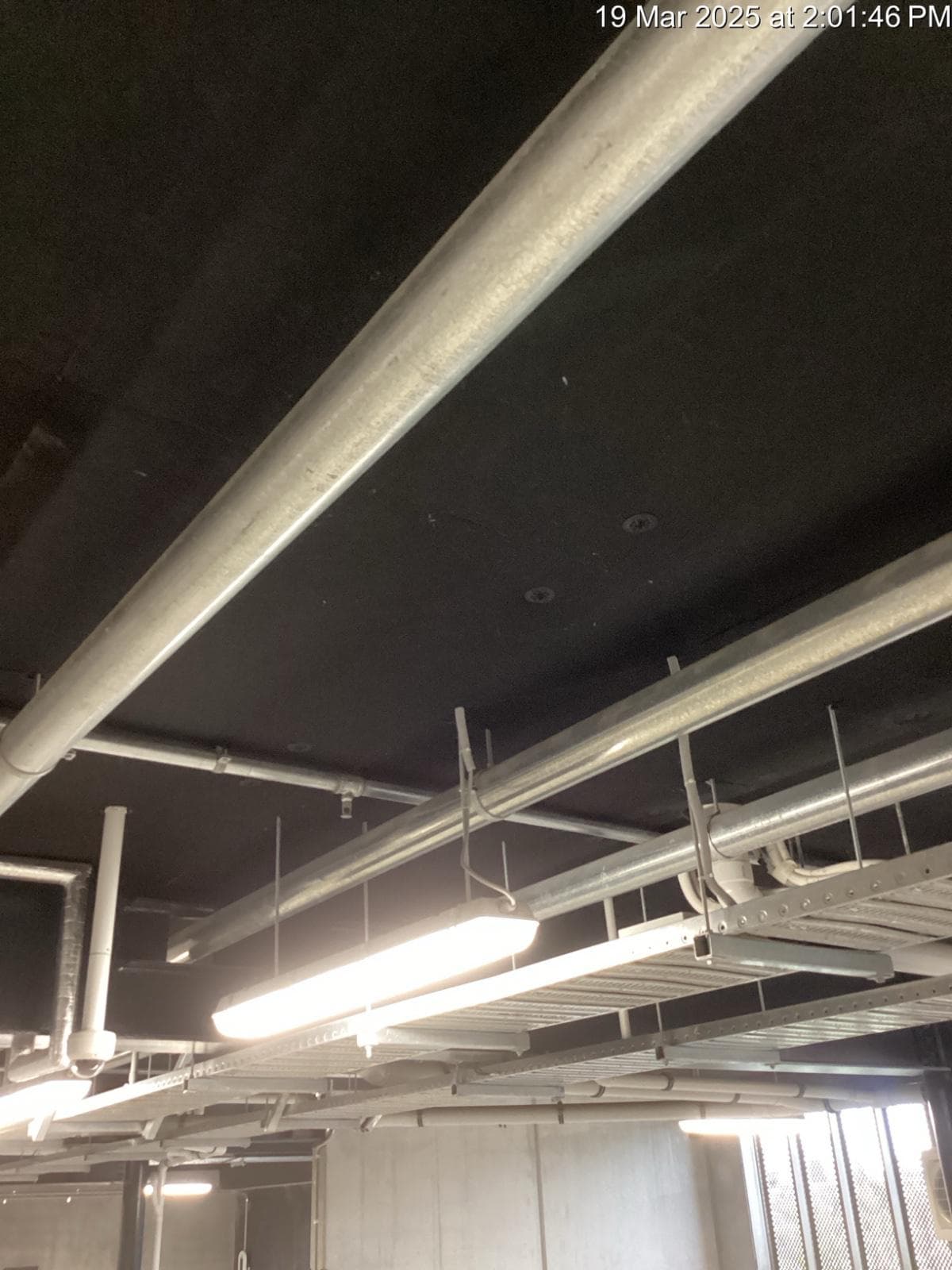
Certification & Compliance Carpark Soffits
Ask which certificate. Then read its scope.
They rarely cover what people assume.
- Group Numbers
- BRANZ scope
- CodeMark limits
- No FRR exists
Auckland based, nationwide
We travel. Most regions have no carpark soffit crew of their own.
Programme focused
We plan and deliver around your schedule.
QA & PS3 supplied
Complete documentation at practical completion.
Commercial specialists
Carparks, basements and podiums.
Carpark soffit linings are regulated as internal surface finishes under NZBC Clause C, which means they are assessed on their Group Number rather than on a fire resistance rating. No soffit insulation product sold in New Zealand carries an FRR, and none of the four systems in common use holds a full BRANZ Appraisal covering the carpark soffit application. All four rely on fire test reports and certificates instead. That is normal for the category, and it is the thing most often assumed wrong when a specification is written.
What Group Number does a carpark ceiling need?
A Group Number classifies how a surface lining contributes to fire growth. It is set by a standard fire test called a room-corner test. The test builds a small room, sets a fire in the corner, and measures how fast flame spreads across the lining and how much smoke it makes. New Zealand accepts two versions: ISO 9705, which is full size, and ISO 5660, which is a bench-scale test on a small sample.
The ordering, best to worst, is 1-S, 1, 2-S, 2, 3, 4. The S denotes additional smoke production performance — which matters in a carpark specifically, because it is a confined space with limited natural ventilation and a real fuel load sitting in it. Smoke production from the ceiling lining is not a theoretical concern there.
For an ordinary carpark this is undemanding. A carpark is an occupied space in the code's all other locations category, where Group 1, 2 or 3 is accepted whether or not the building is sprinklered. All four systems clear that comfortably.
It stops being undemanding in three situations: where the space is or contains an exitway, where the building is Importance Level 4, and where an unsprinklered soffit is the ceiling to a sleeping or crowd area. In all three the requirement is Group 1-S — which the polyester liners meet and the phenolic boards do not.
| System | Material | Classification | Basis |
|---|---|---|---|
| Mammoth Carpark Panel | 100% polyester | Group 1-S | ISO 9705:1993, and AS ISO 9705:2003 which is the Australian adoption. BRANZ fire reference FAR-4587-TO. |
| GreenStuf ASL | 100% polyester | Group 1-S | ISO 9705:1993. FAR4045 for unfaced and black; FC10711-01 / FI 5550 for foil-faced. |
| Kingspan Kooltherm K10 G2 | Rigid phenolic | Group 2-S | AS ISO 9705:2003 — the Australian adoption of ISO 9705 — assessed against NZBC Clause C3.4. |
| GreenStuf Phenolic Foam Board | Rigid phenolic | Group 2-S | By correlation from EN 13501-1 Class C s1 d0, not a direct ISO 9705 test. |
Rigid phenolic board is frequently specified into basements on the assumption that it is the fire-rated option. It sits two places below the polyester liner it would replace on the ordering above. Specify board for depth. It buys you nothing on fire.
Does carpark soffit insulation carry a fire resistance rating?
This is the most common misunderstanding in the category, and it matters because it changes who is responsible for what.
Where a carpark slab needs a fire resistance rating, that requirement lands on the floor and the structure holding it up. Not on the lining. The rules sit in a document called C/AS7, which covers vehicle storage and parking. The rating is 60 minutes, or 30 minutes if the building has sprinklers. Where two different building uses share a floor, the higher rating applies to the shared spaces and escape routes.
That rating is achieved by the concrete and its supporting structure. It is not achieved by anything fixed to the underside of it, and no manufacturer of a soffit insulation product claims otherwise. If a specification or a fire report appears to require an FRR from the lining itself, resolve it before anyone prices it. No product on the market will satisfy it.
One related question belongs with the project fire engineer. Some slabs are rated fire separations, meaning the floor itself is relied on to hold a fire back for a set time. That rating comes from a test of a specific build-up. Fixing a combustible foam board to the underside changes the build-up, and the rated system was not tested with one on it. We found no New Zealand ruling or manufacturer statement either way, so treat it as an open question and put it to the fire engineer at design stage.
Is any carpark soffit insulation BRANZ appraised?
Three words get used as if they mean the same thing: appraised, certified and tested. They do not. BRANZ is New Zealand's building research organisation, and it issues several different documents. A full Appraisal is the strongest — it assesses a product for a stated use. A fire test report only records how the product behaved in one test. CodeMark is a separate certification scheme, and a CodeMark issued in Australia does not apply here. Every one of these is checkable in a minute, and the scope is where the answer lives.
Mammoth Carpark Panel
Mammoth hold BRANZ fire reference FAR-4587-TO and describe the panel as BRANZ tested, which is what it is. A fire reference records how the product performed in a fire test. It is not a full Appraisal, and Mammoth do not claim one for this application.
GreenStuf ASL
Two fire references depending on facing: FAR4045 for unfaced and black, FC10711-01 and FI 5550 for foil-faced. BRANZ Appraisal 380 does exist for Autex GreenStuf insulation, but its scope is framed and part-framed walls, ceilings and roofs. It does not name ASL, and it does not cover the phenolic board.
Kingspan Kooltherm K10 G2
Holds CodeMark certificate CM20201 — which is a CodeMark Australia certificate assessed against the Building Code of Australia. It does not cover New Zealand. Read its exclusions. They show where the certifier was not comfortable: unsprinklered Class 3 and 9a public corridors, fire-isolated exits, and fire control rooms.
GreenStuf Phenolic Foam Board
No BRANZ Appraisal and no CodeMark. Its Group 2-S comes by correlation from a European classification rather than a New Zealand test report. MBIE publish that correlation so the route is legitimate, and a building consent authority is still entitled to ask about it. Better to have the answer at tender than at review.
That is how the category works, and every manufacturer is in the same position. If a supplier or another installer tells you a soffit product is BRANZ appraised for a carpark, ask which appraisal number, then read its scope.
What R-value does H1 require over a carpark now?
H1/AS1 Sixth Edition took effect on 27 November 2025 and removed the schedule method entirely. There is no longer a prescriptive table you can look up for a floor over a carpark. Compliance is demonstrated by the calculation method or the modelling method, which means the required figure is specific to the building rather than fixed by climate zone.
The Fifth Edition Amendment 1 can still be used for consent applications lodged up to 26 November 2026. Under its schedule method, Table 2.1.2.2B set a minimum construction R-value of R2.5 for a floor other than slab-on-ground in climate zone 1. A suspended concrete floor over an open carpark is not in contact with the ground, so the slab-on-ground figure never applied to it.
Two things narrow it further. H1/AS1 applies to housing, and to other buildings with no more than 300m² of occupied space. An apartment building over a carpark counts as housing. A retirement village, rest home or aged care building does not — those are classed as communal residential and go to a different document, H1/AS2. So does any non-housing building over 300m². And R2.5 describes the whole assembly as built, which is a different number from the one printed on a panel.
So if a specification quotes R2.5 and cites the schedule method, check when the consent was lodged. On a new project the figure should be coming out of a calculation or a model, and it may not be R2.5. We install what the specification calls for — and if the specification and the code route disagree, we say so before we price it.
What we do with this on a real project
- We put the actual certificate in front of you at tender, with its scope, rather than a datasheet summary of it.
- We do not substitute an equivalent product without the engineer's sign-off. Equivalent R-value is not equivalent Group Number, and it is not equivalent acoustic absorption.
- Where the specification, the fire report and the product certificate do not line up, that comes back with the quote rather than surfacing at the fire engineer's review.
- Manufacturer documentation is handed over with the QA pack at practical completion.
Installed to the specified system, documented
We install soffit insulation to concrete carpark, basement and podium soffits throughout New Zealand, from a base in Auckland. We install the specified system rather than an equivalent, and we hand over the manufacturer's documentation with the QA pack so compliance is evidenced rather than assumed.
Installed to AS/NZS structural fixing requirements.
Get your specificationchecked
Send drawings, the specification and the fire report if there is one. If something in them will not do what it is assumed to do, that comes back with the quote.
- Fast turnarounds — within 24–48 hours
- Certificates supplied at tender, not just datasheets
- Specification conflicts raised before pricing
Your project details are kept confidential.
Certification — common questions
- Is carpark soffit insulation fire rated?
- No soffit insulation product sold in New Zealand carries a fire resistance rating. Carpark soffit linings are internal surface finishes, so they are assessed on their Group Number instead. Where a carpark slab needs a fire resistance rating, the rules place that requirement on the floor and the structure holding it up. The rating is 60 minutes, or 30 if the building is sprinklered. The concrete and its supporting structure satisfy it.
- What Group Number does a carpark ceiling need?
- Carparks fall in the code's all other locations category, which accepts Group 1, 2 or 3 whether or not the building is sprinklered. Group 1-S is required where the space is or contains an exitway, where the building is Importance Level 4, or where an unsprinklered soffit is the ceiling to a sleeping or crowd area. Mammoth Carpark Panel and GreenStuf ASL are Group 1-S. Kingspan Kooltherm K10 G2 and GreenStuf Phenolic Foam Board are Group 2-S.
- Is any carpark soffit insulation BRANZ appraised?
- Not for the carpark soffit application. Mammoth hold BRANZ fire reference FAR-4587-TO. GreenStuf ASL holds fire references FAR4045 and FC10711-01 / FI 5550 — BRANZ Appraisal 380 exists for Autex GreenStuf but its scope is framed walls, ceilings and roofs and it does not name ASL. Kingspan holds CodeMark CM20201, which is an Australian certificate. GreenStuf Phenolic holds neither. All four rely on fire test reports, which is normal for this category.
- What R-value does a carpark ceiling need under H1?
- There is no longer a fixed figure. H1/AS1 Sixth Edition, effective 27 November 2025, removed the schedule method, so the required R-value comes from a calculation or a model and is specific to the building. Under the Fifth Edition Amendment 1, usable for consents lodged up to 26 November 2026, Table 2.1.2.2B set R2.5 for a floor other than slab-on-ground in climate zone 1. That applied to housing and to other buildings under 300m² of occupied space — retirement villages, aged care and larger commercial buildings go to H1/AS2 instead.
- Can I substitute an equivalent product with the same R-value?
- Only with the designer's or engineer's agreement, and check more than the R-value before you ask. Equivalent R-value does not mean equivalent Group Number. Substituting a Group 2-S board for a Group 1-S liner downgrades the fire classification. It is not equivalent acoustically either, because rigid closed-cell boards are not acoustic products and polyester liners publish absorption figures from NRC 0.65 to 1.05. Substitutions surface at the fire engineer's review, and removing an installed carpark ceiling is not a cheap variation.
Sources
Every figure on this page traces to one of the documents below. Where a manufacturer publishes conflicting versions, that is stated in the text rather than resolved silently.
- MBIE — surface finishes and Group Numbers
- NZBC C/AS7 — protection from fire, vehicle storage and parking
- NZBC C/VM2 — verification method, protection from fire
- H1/AS1 Sixth Edition — energy efficiency
- MBIE — what changed in H1/AS1 Sixth Edition
- BRANZ FAR-4587-TO — InsulPro Mammoth Carpark Panel
- BRANZ — Autex GreenStuf Insulation, Appraisal 380
- BRANZ — Autex Soffit and Slab Liner certification
Last updated